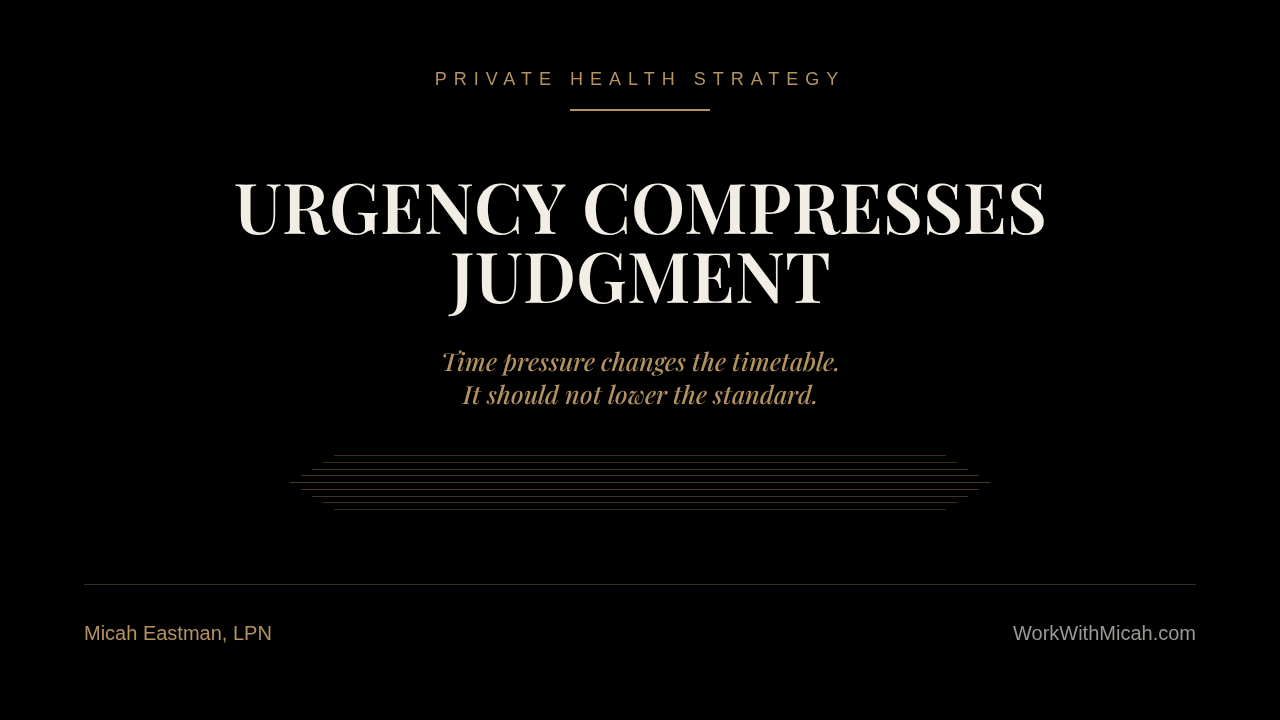
Urgency Compresses Judgment
Urgency can shorten the timetable without changing what matters. Micah Eastman explores how families can protect judgment when important healthcare decisions have to be made quickly.
See the situation more completely.
Showing article content
Perspectives brings together nurse-led observations, family health governance principles, lived experience, and systems thinking to help families and trusted advisors recognize hidden risks, ask better questions, and identify the next responsible step.

Urgency can shorten the timetable without changing what matters. Micah Eastman explores how families can protect judgment when important healthcare decisions have to be made quickly.

Families often know something has changed before they can clearly name the problem. Micah Eastman reflects on why the first responsible step is sometimes simply to stop, observe, and establish what is true today.

Families can receive accurate healthcare information and still go home uncertain about what happens next. Micah Eastman reflects on the gap between information being given and information being understood well enough to act on.

Professional titles define authority and scope. They should never become a measure of human worth, intelligence, or whose observations deserve to be heard.

Unity does not require sameness. Micah Eastman reflects on different gifts, responsibilities, measures, and expressions—and why distinction does not have to become division.

Perspective can change what becomes visible without changing the truth itself. Micah Eastman reflects on observation, experience, humility, and the discipline of learning to see more completely.

After more than three decades in healthcare, Micah Eastman reflects on what bedside experience taught him about observation, family burden, context, and the importance of seeing what formal care plans can miss.

In many families, one person gradually becomes the memory, coordinator, communicator, and source of continuity for an entire care arrangement. Micah Eastman explores why that responsibility must be made visible—and why caregiver sustainability is part of sustainable care.

Aging in place is often discussed as a question of location. But as health needs become more complex, the more important question is whether the structure around the person can continue to support them responsibly.

Fragmentation persists. Responsibilities blur. Information remains scattered. And families are forced to make consequential decisions without one coherent view.

Private health strategy helps families and trusted advisors see the relationships among the person, care team, household, responsibilities, risks, resources, and decisions ahead.